2: Blurring Boundaries
3/1/20267 min read
Blurring Boundaries
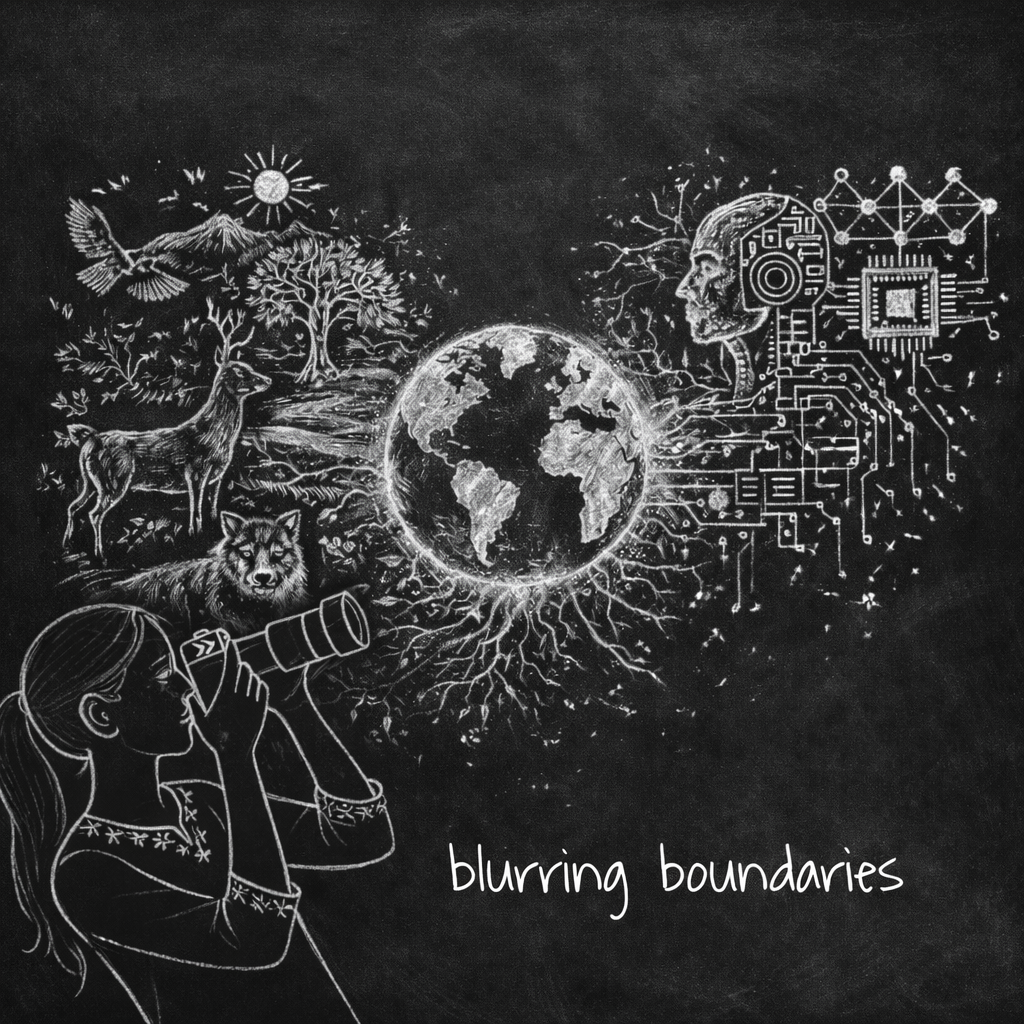
A bird wakes without a calendar. An ant leaves its colony without a map. What looks like chaos from the outside turns out, on closer inspection, to be something far more interesting, a form of coordination so distributed, so ancient, that we simply do not have a good word for it yet.
Life does not need a centre to hold itself together. It never did. And the closer we look at how living things sustain themselves across time, the more the boundary between self and world, between one organism and another, begins to blur in the most astonishing ways.
How does nature coordinate without anyone in charge?
In 1959, the entomologist Pierre-Paul Grasse observed termites building mounds of extraordinary precision, ventilation shafts, nurseries, thermal regulation, with no blueprint and no foreman. He called it stigmergy: an organism leaves a trace in the environment, and that trace becomes the instruction for the next action (Grasse, 1959). The environment itself carries the message.
Ants find the shortest path to food through pheromone trails that strengthen with use, until the colony navigates with a precision no single ant possesses (Dorigo & Gambardella, 1997). Slime moulds with no brain or neurons independently replicated the layout of the Tokyo rail network when nutrients were placed at points corresponding to cities (Tero et al., 2010). Forests exchange carbon and distress signals through underground fungal networks, a tree under attack warns its neighbours before any threat arrives (Simard et al., 1997).
No headquarters. No hierarchy. Just signal, response, and an environment that carries the conversation forward across time.
What do the oldest living things on Earth have in common?
The Greenland shark can live beyond 400 years, reaching maturity at around 150 (Nielsen et al., 2016). The bristlecone pine Methuselah has stood for over 5,000 years, growing perhaps one millimetre annually, every millimetre a response to soil, temperature, moisture (Schulman, 1958). The immortal jellyfish reverts to its juvenile state when stressed, resetting its biological clock entirely (Piraino et al., 1996). The ocean quahog clam has been recorded at 507 years old (Butler et al., 2013).
None of them resist the signals of their environment. All of them are in continuous, calibrated conversation with it. Their longevity is not despite their dependence, it is because of it.
Where does your body end and the world begin?
In 1901, Jagdish Chandra Bose demonstrated at the Royal Institution that plants respond to stimuli the way animals do, flinching, fatiguing, recovering, and argued for a universal pulse of life connecting all living things (Bose, 1926). The scientific establishment was not ready. He was a century ahead of his time.
Today, research shows that time among trees measurably reduces cortisol, lowers blood pressure, and increases immune activity through inhaled phytoncides, volatile compounds the trees release (Li et al., 2008). The vagus nerve continuously scans the environment for signals of safety below the threshold of conscious awareness, which is why a forest feels like relief before you know why (Porges, 2011). The trillions of microorganisms in the gut synthesise neurotransmitters and communicate with the brain in ways still being understood (Cryan et al., 2019). And physical touch triggers oxytocin, two nervous systems briefly, genuinely, confirming each other's existence (Uvnäs-Moberg, 1998).
The boundary is real enough to walk through a door. It is not solid enough to explain what we are.
Did ancient cultures already know this, and build with it?
Stepwells across the Indian subcontinent encoded groundwater intelligence into architecture, you could read the depth of the water table by watching where water met the steps. Communities timed rituals to them. The structure was a message left in stone for those who came after (Livingston & Beach, 2002). Persian qanats, some still flowing after 3,000 years, were built by reading hillside hydrology as a felt sense rather than a calculation (Lightfoot, 1996). Aboriginal Australians maintained continental-scale fire management for over 50,000 years, a conversation with the land in which human action shaped the environment that shaped the next action (Gammage, 2011). The Vedic Panchanga, Mayan agricultural calendars, Chinese lunar almanacs, all sensing technologies, encoding accumulated environmental intelligence in ritual so the signal would survive even when the individual who understood it did not (Aveni, 1989).
What happens when the signal gets noisy?
Money began as a proxy for trust, a way to carry the information of a relationship across distance and time (Graeber, 2011). Grades began as a proxy for understanding. Follower counts as a proxy for connection. Each was designed to compress complexity into something legible. But legibility comes at a cost: it flattens the local, the qualitative, the felt, precisely the signals that living systems depend on (Scott, 1998). When the proxy replaces what it pointed to, the signal loses its referent. It is still received. It just stops being true.
Mirror neurons fire both when we act and when we witness another acting, empathy has a biological substrate, not just a moral one (Rizzolatti & Craighero, 2004). The mind, as interpersonal neurobiology proposes, emerges not only from the individual brain but from the relational field between people (Siegel, 2012). Ritual, grief, story, these are not decorative features of culture. They are signal-transmission systems. They synchronise nervous systems across communities. Losing them is losing a technology, quietly, without a funeral.
The tortoise does not optimise. The bristlecone pine does not disrupt. The Greenland shark does not scale. What they do is remain in continuous conversation with everything around them, treating the boundary between self and world not as a wall to defend but as a membrane through which information moves.
Bose was right. There is a pulse. It runs through fungal networks and vagus nerves, through the geometry of a stepwell and the arc of a pheromone trail. It is the signal of life sustaining itself through connection, through the endless, mostly invisible transmission of information between everything that lives.
The boundary was always permeable. The wonder is in noticing.
Questions Worth Sitting With
For those willing to look a little further.
For all of us
If your nervous system is already reading the world before your mind catches up, what signals have you been overriding, and what might you hear if you paused long enough to let them through?
The oldest living things on Earth survived not by controlling their environment but by staying in conversation with it. What would it mean to bring that quality of attention into a single day?
We inherit the accumulated signal of every generation before us, in language, ritual, architecture, story. What signals are we leaving in the environment for those who come after, and are they ones we would choose if we were paying attention?
For conservationists
Stigmergy tells us that ecosystems self-coordinate through trace and response. When we restore a habitat, are we restoring the signals too, the chemical conversations between species, the fungal networks, the acoustic signatures of a healthy place, or only the visible parts?
The stepwell, the qanat, the fire-managed landscape, each was a technology built on intimate, multigenerational reading of a specific place. What local environmental knowledge exists right now, held by communities outside research institutions, that has not yet been listened to?
Biodiversity is often measured in species counts. But if connection is the operating mechanism of life, what would it mean to also measure the density and health of the signals between species, the relationships, not just the nodes?
Some of the longest-lived organisms on Earth are also the slowest. In a field often driven by urgency, what would conservation look like if it made space for processes that operate on timescales we cannot observe within a single grant cycle?
For those building AI
Slime moulds solve complex network problems with no central processor, the solution emerges from the interaction between organism and environment over time. What would it mean to design AI systems that learn the way stigmergy works, through trace, response, and the environment as an active participant rather than a passive dataset?
The vagus nerve does not just process information, it continuously scans for safety, shaping what the organism is even capable of perceiving. If AI systems are increasingly part of the environment that human nervous systems are scanning, what signals are they emitting, and are those signals conducive to the kind of open, curious attention that good thinking requires?
Bose found a universal pulse connecting plant, animal, and human along a biological continuum. The boundary we draw between natural intelligence and artificial intelligence may be as permeable as the ones this article has explored. What responsibilities come with that possibility?
Human cultures embedded environmental knowledge in ritual, story, and structure so that the signal would outlast the individual who understood it. AI systems trained on human language inherit that signal, compressed, filtered, and imperfectly. What is being lost in that compression, and how would we even know?
If the oldest, most resilient living systems on Earth sustain themselves through connection rather than control, through distributed sensing rather than centralised command, what does that suggest about the architectures we are building, and the ones we are not?
References
Aveni, A. F. (1989). Empires of time: Calendars, clocks, and cultures. Basic Books.
Bose, J. C. (1926). The nervous mechanism of plants. Longmans, Green and Co.
Butler, P. G., Wanamaker, A. D., Scourse, J. D., Richardson, C. A., & Reynolds, D. J. (2013). Variability of marine climate on the North Icelandic Shelf in a 1357-year proxy archive based on growth increments in the bivalve Arctica islandica. Palaeogeography, Palaeoclimatology, Palaeoecology, 373, 141–151.
Cryan, J. F., O'Riordan, K. J., et al. (2019). The microbiota-gut-brain axis. Physiological Reviews, 99(4), 1877–2013.
Dorigo, M., & Gambardella, L. M. (1997). Ant colonies for the travelling salesman problem. BioSystems, 43(2), 73–81.
Gammage, B. (2011). The biggest estate on Earth: How Aborigines made Australia. Allen & Unwin.
Graeber, D. (2011). Debt: The first 5,000 years. Melville House.
Grasse, P. P. (1959). La reconstruction du nid et les coordinations inter-individuelles chez Bellicositermes natalensis et Cubitermes sp. Insectes Sociaux, 6(1), 41–83.
Knoll, A. H. (2003). Life on a young planet: The first three billion years of evolution on Earth. Princeton University Press.
Li, Q., Morimoto, K., et al. (2008). Forest bathing enhances human natural killer activity and expression of anti-cancer proteins. International Journal of Immunopathology and Pharmacology, 20(2 Suppl 2), 3–8.
Lightfoot, D. R. (1996). Moroccan khettara: Traditional irrigation and progressive desiccation. Geoforum, 27(2), 261–273.
Livingston, M., & Beach, M. (2002). A field guide to the stepwells of Gujarat. Applied Research and Design Publishing.
Nielsen, J., Hedeholm, R. B., et al. (2016). Eye lens radiocarbon reveals centuries of longevity in the Greenland shark. Science, 353(6300), 702–704.
Park, B. J., Tsunetsugu, Y., et al. (2010). The physiological effects of Shinrin-yoku. Environmental Health and Preventive Medicine, 15(1), 18–26.
Piraino, S., Boero, F., Aeschbach, B., & Schmid, V. (1996). Reversing the life cycle. The Biological Bulletin, 190(3), 302–312.
Porges, S. W. (2011). The Polyvagal Theory. W. W. Norton & Company.
Rizzolatti, G., & Craighero, L. (2004). The mirror-neuron system. Annual Review of Neuroscience, 27, 169–192.
Schore, A. N. (2001). Effects of a secure attachment relationship on right brain development. Infant Mental Health Journal, 22(1–2), 7–66.
Schulman, E. (1958). Bristlecone pine, oldest known living thing. National Geographic, 113(3), 355–372.
Scott, J. C. (1998). Seeing like a state. Yale University Press.
Siegel, D. J. (2012). The developing mind (2nd ed.). Guilford Press.
Simard, S. W., Perry, D. A., et al. (1997). Net transfer of carbon between ectomycorrhizal tree species in the field. Nature, 388(6642), 579–582.
Tero, A., Takagi, S., et al. (2010). Rules for biologically inspired adaptive network design. Science, 327(5964), 439–442.
Uvnäs-Moberg, K. (1998). Oxytocin may mediate the benefits of positive social interaction and emotions. Psychoneuroendocrinology, 23(8), 819–835.